
I had read an interesting story somewhere, a psychiatrist working at a mental health institution was on his rounds. He saw two elder gentlemen in an animated conversation. Being curious, he decided to observe closely. He found it interesting that when one person was speaking, the other person listened intently as though he was absorbing every word of the other. Then, when the other person stopped, he started talking, but spoke something entirely unrelated to what the other person spoke. The other person was also listening intently without interrupting and did exactly the same thing.- Started speaking something completely unrelated.
The psychiatrist was initially bemused, but later got contemplative. He shared this incident with a couple who were his friends. They all had a good laugh. However, after that he sombrely told them, “when you come to me to resolve a fight between you’ll or I visit you when you both are arguing, I see no difference in you’ll and those individuals at the institution.” The couple felt indignated till he made himself clear.
He said, “When you argue, A speaks something and B, who is emotionally disturbed at the time, starts speaking something totally unrelated, about the past etc, having no relevance to what is happening in the moment. So both of you are only listening to the chatter of your respective minds and wait to vomit that out without acknowledging, accepting, or even pausing to gauge what the other person is saying. “
How many of you identify with this experience? As though years or days of accumulated grime of suppressed, un-communicated thoughts, feelings erupt and the ashes of resentment, anger, sadness spread far and wide falling on the kids and other family members.
So, do we truly listen? Or are we simply hearing.
In Relating:-
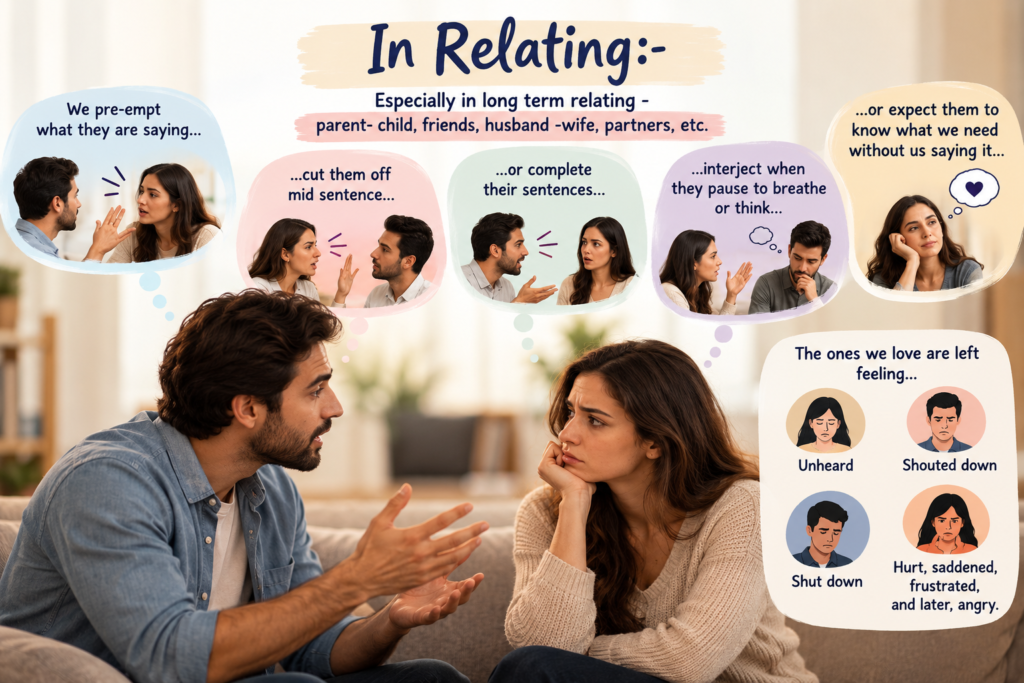
Especially in long term relating- parent- child, friends, husband -wife, partners, etc.
There is a preconceived presumption that we know what the other person is going to say and we pre-empt what they are saying- cutting them off mid sentence, completing sentences, which might be true but, more often than not, are not true. At times, interjecting when they have just paused to breathe or ponder before continuing, cutting their stream of thought and saying what we have on our minds which we “think” is what they want to say. Or, worse, without communicating what we need, we expect our “loved ones” to know what we think, as though we are somehow transported to “Satyug” or have developed some telepathic powers conjured up on the go.
I, for one, get blindsided quite a few times when talking to a loved one, where I do, or have done in the past, all of the above.
The ones we love are left feeling unheard, shouted down, shut down. This can leave the other person quite hurt, saddened, frustrated and later, angry.
In Addiction:-
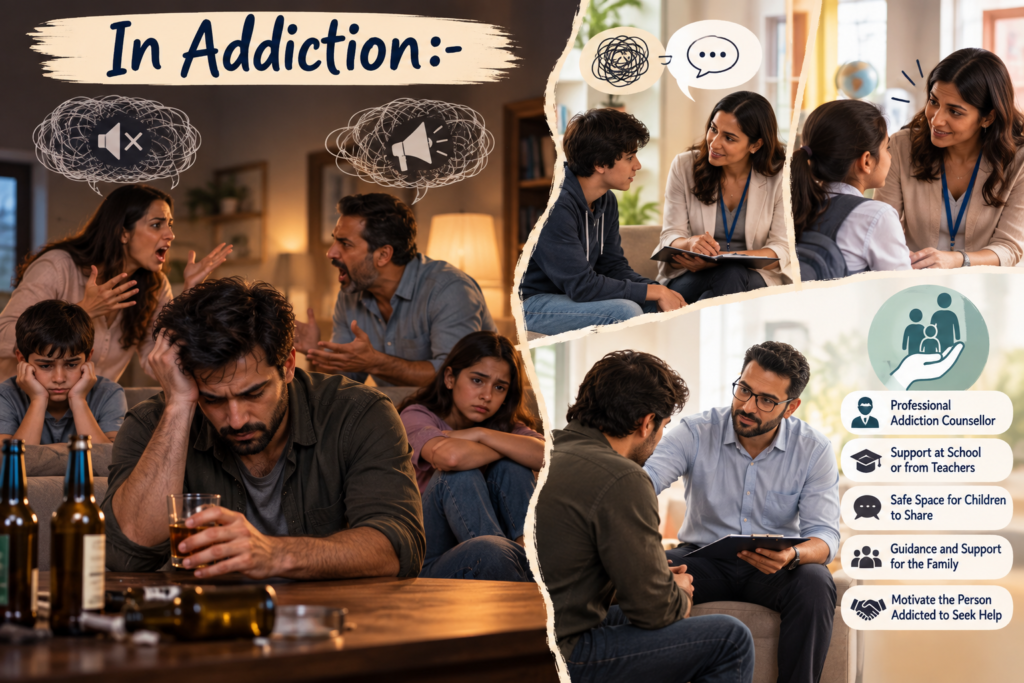
Another situation in which one feels nobody is “listening “ is when the disease of addiction engulfs a family. The person intoxicated and entrapped in addiction is no longer available to listen truly. The spouse and family only shout louder and louder and nobody listens. Children grow up distressed and end up with behaviour changes and social challenges. Somebody to listen to them, with whom they can share safely, should be present outside of the home- a counsellor at school, a teacher, a professional counsellor of addiction to support the family. The addiction counsellor can motivate the person addicted to seek and accept help.
Mobile Phones:-
In today’s day and age of the world having shrunk into the palm of our hands, our closest relationships seem a world apart though we are all sitting around a dinner table or waiting at a coffee shop.
More often than not, I have seen and experienced many a time, one person is speaking, trying to speak something that is on his/her mind, and the person whom he/she is speaking to is busy on their mobile phone, at the same time insisting that they are “listening”. There is, I am sure, nothing lonelier than being sidelined in a conversation by an inanimate object.
Suicides:-
September is World Suicide awareness month.
More than 720,000 people die by suicide globally each year, according to the World Health Organization (WHO).
World is dwindling from joint families to nuclear families to singular “families”. Is there is nobody to “listen “ who does one talk to?
The world is increasing filling with people who don’t know how to express what they feel, where one has to take an appointment to speak with “friends”. Friendship has a different connotation to different generations.
All that a human being needs is true connection, to be listened to, to be themselves, to be witnessed.
Current Communications and Connections:-
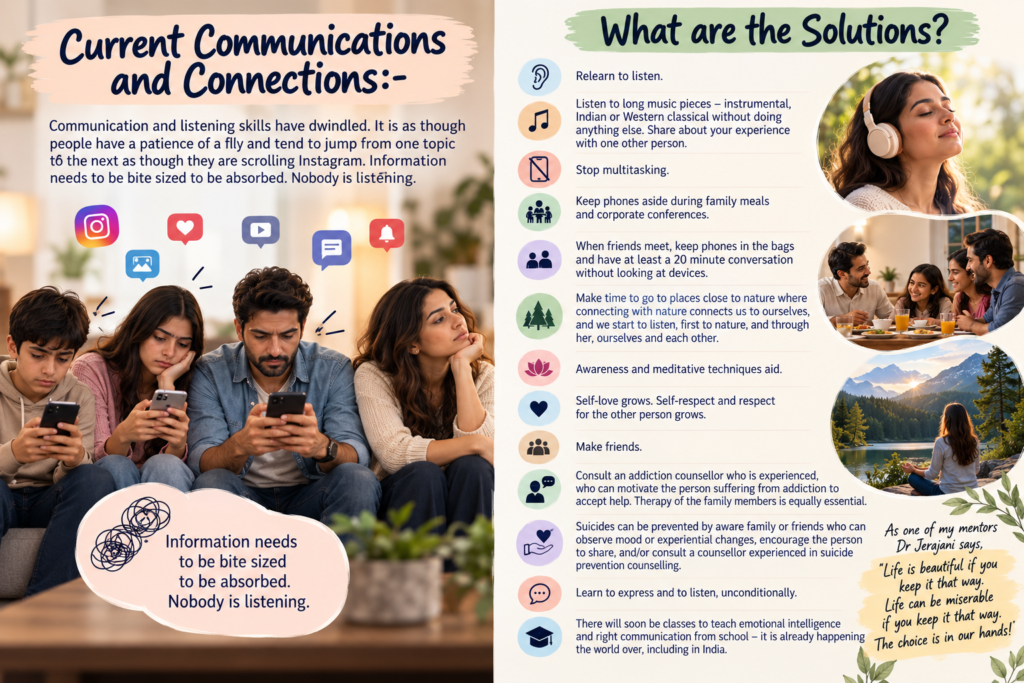
Communication and listening skills have dwindled. It is as though people have a patience of a fly and tend to jump from one topic to the next as though they are scrolling Instagram. Information needs to be bite sized to be absorbed. Nobody is listening.
What are the Solutions?
- Relearn to listen.
- Listen to long music pieces – instrumental, Indian or Western classical without doing anything else. Share about your experience with one other person.
- Stop multitasking.
- Keep phones aside during family meals and corporate conferences.
- When friends meet, keep phones in the bags and have at least a 20 minute conversation without looking at devices.
- Make time to go to places close to nature where connecting with nature connects us to ourselves, and we start to listen, first to nature, and through her, ourselves and each other.
- Awareness and meditative techniques aid.
- Self-love grows
- Self -respect and respect for the other person grow.
- Make friends
- Consult an addiction counsellor who is experienced who can motivate the person suffering from addiction to accept help. Therapy of the family members is equally essential.
- Suicides can be prevented by aware family or friends who can observe mood or experiential changes in the concerned person, encouraging the person to share, and or consult a Counsellor experienced in guiding through suicide prevention counselling.
- Learn to express and to listen, unconditionally.
- There will soon be classes to teach emotional intelligence and right communication from school- it is already happening the world over, including in India. Identifying emotions, connecting with its feeling on the body and sitting with it, enables one to reduce the intensity and move beyond their lingering effects.
- As one of my mentors Dr Jerajani says, Life is beautiful if you keep it that way. Life can be miserable if you keep it that way. The choice is in our hands!“