Understanding the intricate relationship between undiagnosed ADHD and addiction is crucial for families and individuals seeking to break free from the cycle of substance abuse. Many traditional addiction treatments fail because they focus solely on symptom management rather than addressing the root causes. ADHD, often undiagnosed in adults, can lead to impulsive behaviors and emotional dysregulation, which in turn may result in self-medication through substance use. Recognizing this link is essential for fostering long-term recovery and meaningful change.
Substance use is frequently a coping mechanism for those grappling with undiagnosed ADHD, a condition characterized by an unrelenting search for dopamine and a struggle with impulsivity. This article will delve into why treating addiction in isolation offers only a reprieve. Instead, focusing on the underlying behavioral patterns and emotional regulation issues associated with ADHD can pave the way for sustainable recovery. Anatta’s non-medical, holistic approach offers a solution that prioritizes individual-focused treatment and privacy, setting it apart as a transformative path to recovery.
What is Undiagnosed ADHD in Adults?
Adult ADHD is often overlooked because its symptoms can be mistaken for personality traits or stress-related behaviors. These symptoms include impulsiveness, difficulty concentrating, and emotional instability. Unlike children, adults with ADHD may not exhibit hyperactivity, making the condition harder to detect. This can lead individuals to develop coping mechanisms that mask their symptoms, further complicating the diagnostic process.
In adults, ADHD can manifest as
- a persistent restlessness,
- a tendency to procrastinate,
- an inability to complete tasks
- an inability to manage time, e.g., if one has to arrive at say 10 am for an appointment, one will obsess over the time to leave but ultimately leave at 10 am. It baffles even them
These behaviors are often attributed to stress or lifestyle choices rather than a neurological condition. As a result, many adults remain undiagnosed, unaware that their struggles have a medical basis. The lack of diagnosis means that these individuals are not receiving the appropriate treatment or support, which can lead to further psychological and emotional issues.
Without proper recognition and treatment, adults with ADHD may turn to substances as a way to self-medicate. The temporary relief provided by drugs or alcohol can seem like a solution, but it ultimately exacerbates the problem. The cycle of self-medication leads to addiction, creating a dual problem that requires a comprehensive approach to treatment.
Link Between ADHD and Addiction
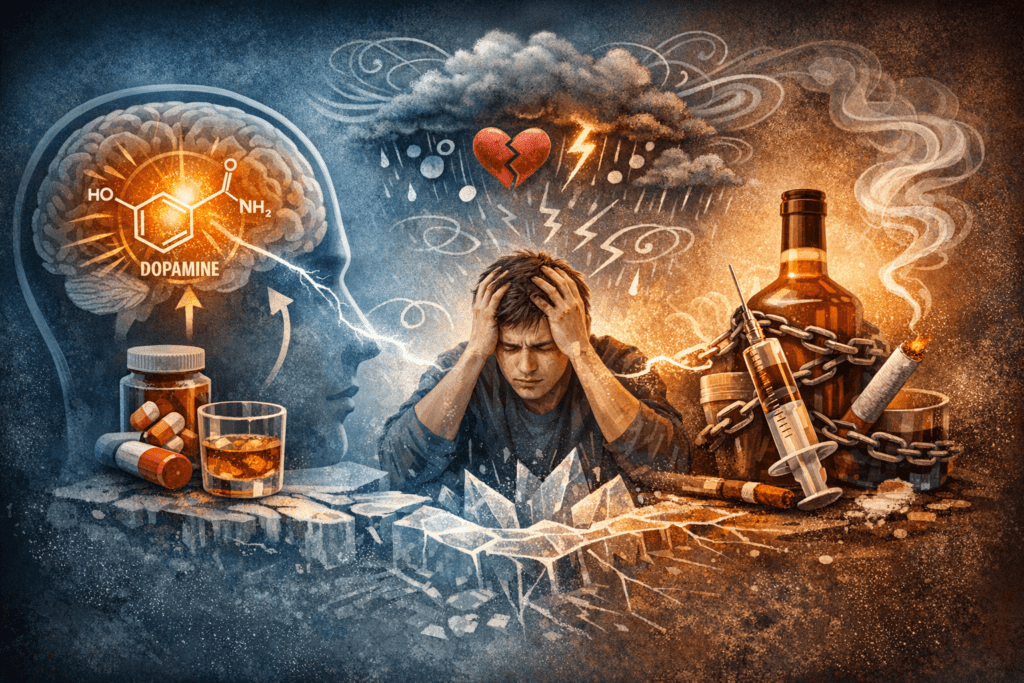
The connection between ADHD and addiction lies in the brain’s reward system. Individuals with ADHD often have lower levels of dopamine, the neurotransmitter responsible for pleasure and reward. This deficiency drives them to seek out activities or substances that provide a dopamine boost, leading to impulsive behaviors and, in many cases, substance use.
Emotional dysregulation is another critical factor linking ADHD and addiction. People with ADHD experience heightened emotional responses, overwhelming emotions that lead to a freeze mode in their minds, making it very difficult for them to identify, feel, and express what they feel, thereby finding it challenging to manage their emotions effectively. Substances can temporarily alleviate these overwhelming feelings, creating a dependency that spirals into addiction.
Recognizing this link is vital for effective treatment. By understanding that ADHD is not just a collection of symptoms but a root cause of addiction, treatment can shift from symptom management to addressing the underlying neurological and behavioral issues. This approach offers a more sustainable path to recovery, as it tackles the problem at its source rather than merely treating its manifestations.
Why Addiction is Often a Symptom, Not the Problem
Addiction is frequently mischaracterized as the primary issue when it is, in fact, always a symptom of deeper, unresolved problems. For individuals with undiagnosed ADHD, substance use is a form of self-medication. The substances temporarily mitigate the challenges posed by ADHD, such as impulsivity and emotional dysregulation, but they do not address the underlying condition.
Treating addiction in isolation is akin to putting a Band-Aid on a deep wound. While it may offer temporary relief, it fails to address the root cause of the problem. This approach can lead to a cycle of relapse and recovery, as the underlying issues remain unaddressed. For lasting change, treatment must focus on identifying and managing the behaviors and emotional challenges associated with ADHD.
Anatta’s approach is designed to break this cycle by addressing the root cause of addiction. Through their Alternate Life Therapy, they focus on understanding the individual’s unique behavioral patterns and emotional needs. This individualized approach allows for more effective treatment, as it targets the source of the problem rather than just its symptoms.
How Families Become Part of the Cycle (Co-dependency)
Families play a critical role in the addiction cycle, often unknowingly contributing to the problem through co-dependency. Co-dependency occurs when family members enable the addictive behavior, either by denying the problem or by providing emotional or financial support that allows the addiction to continue.
Emotional dynamics within families can exacerbate addiction. Family members may feel guilt, shame, or responsibility for their loved one’s behavior, leading them to support or excuse the addiction. This can create an environment where the individual feels unable to change, as their behavior is both enabled and unchallenged.
For effective recovery, families need to become aware of their role in the addiction cycle. Setting boundaries and fostering healthy emotional dynamics can be transformative. Anatta’s approach includes family involvement in the recovery process, encouraging family members to develop awareness and establish boundaries that support the individual’s journey.
Why Conventional Rehab Approaches Fall Short
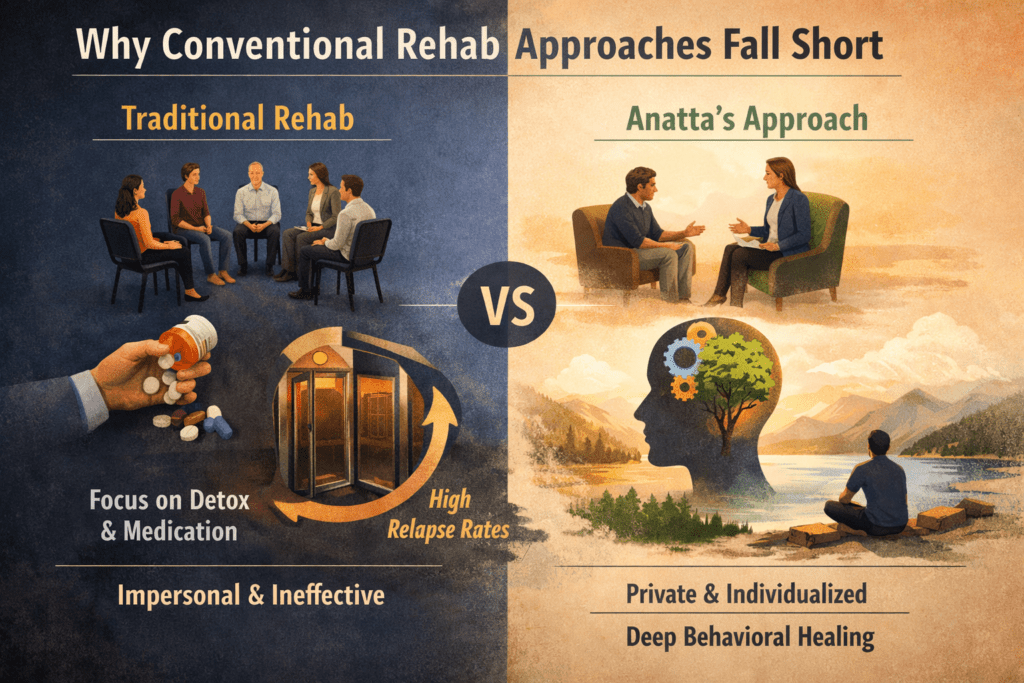
Traditional rehab programs often fall short because they focus on detoxification and symptom management without addressing the underlying causes of addiction. These programs typically rely heavily on medication and group therapy, which may not be suitable for individuals with undiagnosed ADHD.
Group therapy can be ineffective for those with ADHD, as it does not cater to their unique needs and may feel impersonal. Additionally, over-reliance on medication can overshadow the need for behavioral intervention. These approaches fail to address the deep-seated behavioral and emotional issues that contribute to addiction, leading to high relapse rates.
Anatta’s method diverges from these conventional practices by offering a private, individualized recovery journey. Their focus on deep behavioral work rather than surface-level detoxification ensures that the root causes of addiction are addressed, providing a more sustainable path to recovery.
A Different Approach: Treating the Individual, Not the Addiction
Anatta’s holistic approach emphasizes treating the individual to treat the addiction. This involves understanding the unique behavioral patterns and emotional challenges of each person, particularly those related to undiagnosed ADHD. By focusing on the individual, Anatta creates personalized recovery plans that address the root causes of addiction.
Their Alternate Life Therapy is a core differentiator, offering a voluntary, non-medical, holistic approach to recovery. This therapy focuses on counselling, one-on-one meditation, and adopting awareness tools for daily life, helping the individual stay in the present, as well as lifestyle changes, emotional regulation, and behavioral adjustments, providing a comprehensive solution that goes beyond traditional rehab methods.
Privacy and confidentiality are paramount at Anatta, ensuring a safe and supportive environment for recovery. This approach not only respects the individual’s need for privacy but also creates a space where deep, personal transformation can occur without the pressure of group settings.
Signs You May Be Treating the Wrong Problem
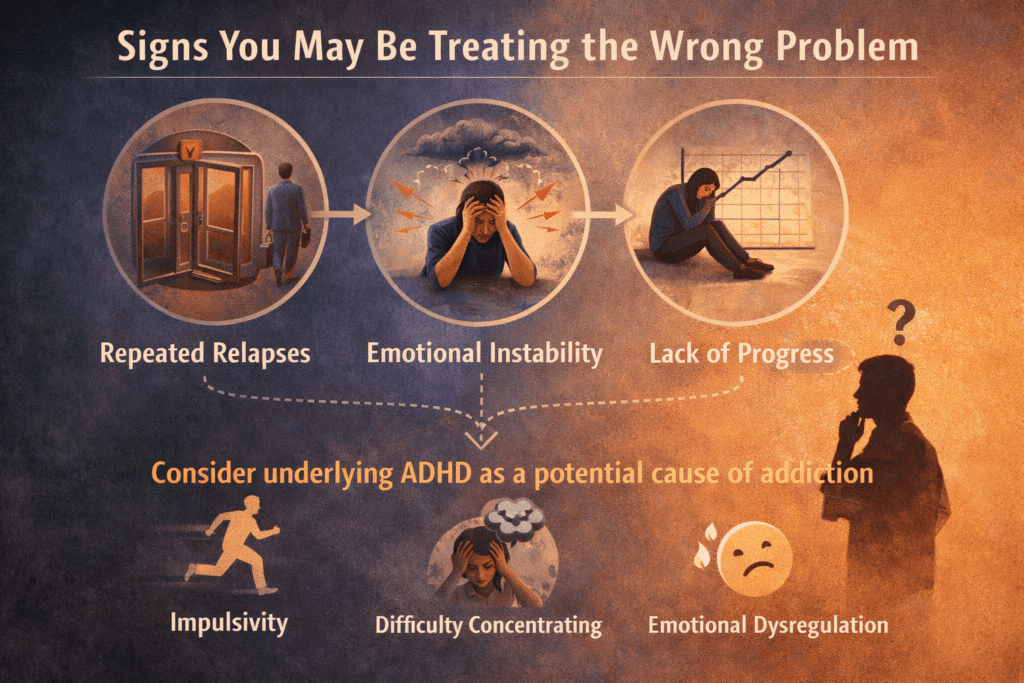
Recognizing when addiction treatment is focusing on symptoms rather than the root cause is crucial for effective recovery. Signs that you may be treating the wrong problem include repeated relapses, persistent emotional instability, and a lack of progress despite treatment efforts.
If traditional rehab methods have failed to provide lasting change, it may be time to consider whether undiagnosed ADHD is at the heart of the issue. Individuals who experience impulsivity, difficulty concentrating, or emotional dysregulation should be evaluated for ADHD as a potential underlying cause of their addiction.
Anatta’s approach helps individuals and families identify these signs and shift their focus to addressing the root causes of addiction. By providing a personalized, holistic treatment plan, Anatta offers a more effective path to recovery that considers the individual’s unique needs and challenges.
A More Sustainable Path to Recovery
Addressing the root causes of addiction, such as undiagnosed ADHD, offers a more sustainable path to recovery. By understanding the behavioral and emotional patterns that contribute to addiction, treatment can focus on creating long-term change rather than temporary relief.
Anatta’s non-medical, holistic approach provides a unique and effective solution for those struggling with addiction. Their emphasis on individualized treatment, emotional regulation, and lifestyle changes ensures that recovery is not just about sobriety but about personal transformation.
For individuals and families looking for a private and personalized recovery experience, you can explore Anatta’s specialized programs through their Rehab Center in Mumbai, designed to offer confidential, one-on-one care in a supportive environment.
If addiction feels like a repeating pattern in your life or the life of a loved one, it may be time to look deeper. Understanding and addressing the root causes, rather than just the symptoms, can lead to lasting recovery and a healthier, more fulfilling life. Families and individuals are encouraged to seek a more personalized, private approach to recovery, where the focus is on the individual and their unique healing journey.